Pembrokeshire has more than fifty beaches, and dogs are welcome on most of them all year round. The restrictions that do exist are seasonal, short, and easy to remember once you have seen them once: two beaches ban dogs outright through the summer, eight more restrict part of their sand or promenade, and everything else is open. Everything below was checked against National Park and council pages in October 2026; where a boundary or a date moves, the reader is pointed at the source rather than given a guess.
The seasonal restrictions run from 1 May to the end of September. Outside that window dogs are welcome again, including on the restricted beaches, so from the start of October the whole coast opens back up until the following spring. Guide dogs and registered assistance dogs are exempt from the beach restrictions throughout the season. The cleanest way to hold all of this: if a beach is not on the short restricted list below, it is open to your dog year-round. The National Park keeps the list on its “Dogs on beaches” page at pembrokeshirecoast.wales, and the council’s “Summer Beach Bans” page mirrors it; both are the place to check before a specific trip.
Between 1 May and 30 September, two beaches take dogs off the sand entirely. Tenby North Beach is one: the town beach tucked inside the harbour, where the whole beach is closed to dogs through the season. Whitesands, at St Davids, is the other. If those are the beaches you had in mind, the practical move is to choose another stretch from the year-round list further down, and come back to Tenby North or Whitesands after September, when both welcome dogs again until the following May.
Eight more beaches restrict dogs on part of the beach or promenade through the same 1 May to 30 September window. The council list runs Amroth (beach and promenade), Broad Haven North, Dale, Lydstep, Newgale (beach and promenade), Poppit Sands, Saundersfoot (beach and promenade), and Tenby Castle Beach with Tenby South Beach. Neither the council nor the National Park page spells out the exact stretch each ban covers, so check the council’s “Summer Beach Bans” page for the boundaries on the day — a partial ban means some part of that beach still welcomes a dog, and the line between the two is the detail that matters. Note the split at Broad Haven: it is the North beach that carries the restriction, while Broad Haven South stays open. It is a small distinction that catches a lot of visitors: a partial ban never means the whole beach, just the stretch the council has marked, and the rest of it stays open to a dog all summer.
The council’s stated approach since 2025 has been education before enforcement. A first offence draws a warning and a request to leave the beach rather than an immediate fixed penalty; the fixed penalty notice is reserved for someone who comes back in or refuses to go. Cllr Rhys Sinnett, Cabinet Member for Residents Services, set out that education-first framing when the 2025 restrictions were announced, and the council newsroom piece that carries it is worth reading if you want the authority’s own wording. Leisure staff enforce the bans, so the answer to “who checks” is the council’s own team on the sand.
Because the restricted list is short, the advice for summer is simply to pick a beach that is not on it. Barafundle Bay, Marloes Sands, Freshwater West, Broad Haven South and Newport Sands are all reliably open to dogs year-round, and they are among the best beaches in the county anyway. The beaches guide sets out what each of them is like; for a dog, any of the five works at any time of year, no list-checking needed.
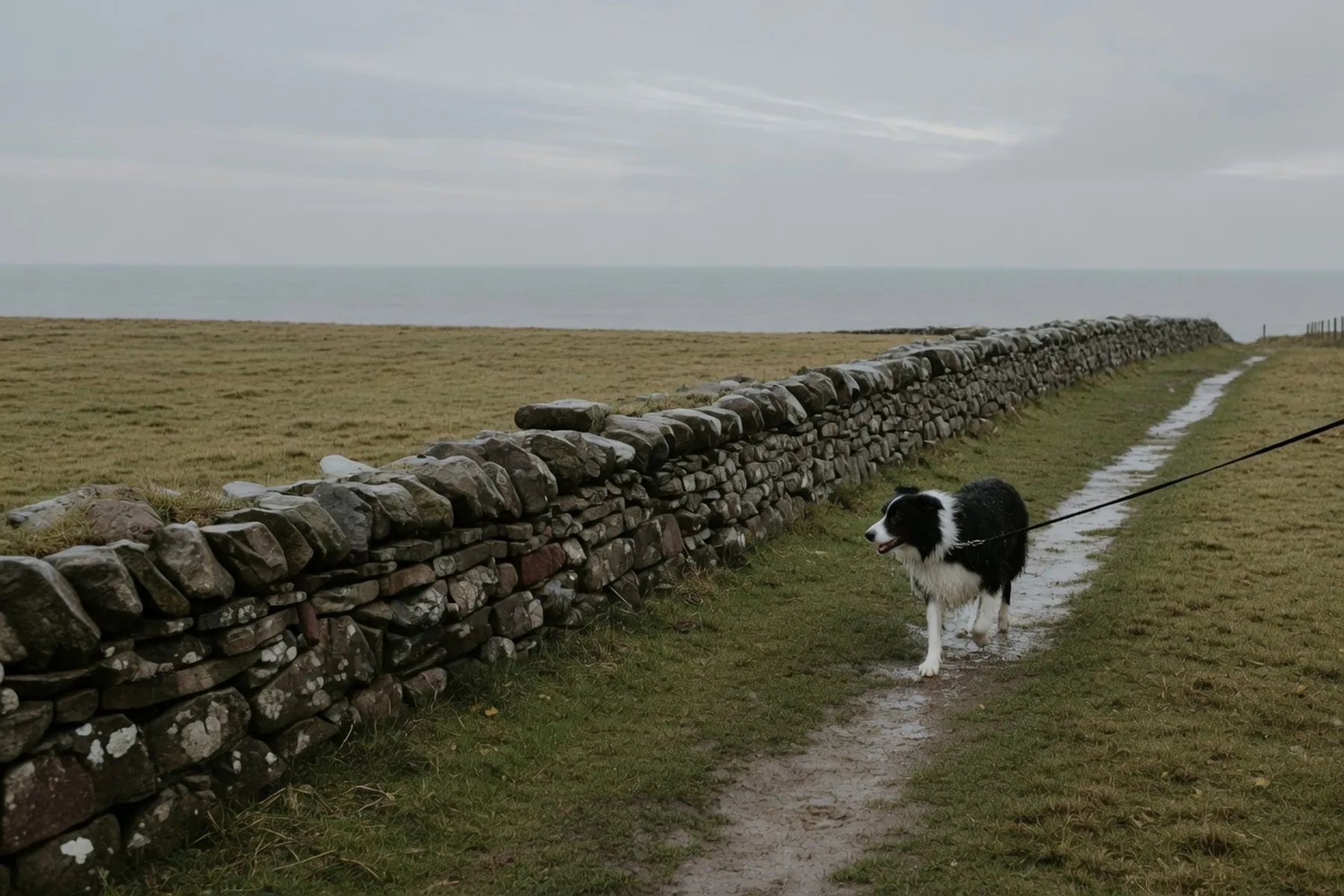
Dogs are welcome on the Pembrokeshire Coast Path but must be kept under close control, preferably on a lead. The path has 31 stiles left, down from about 530 in 1993, and most carry a dog gate alongside — though the largest dogs may not fit through the gate, which is worth knowing if you walk a big breed. The National Park lists the complaints it still receives: people not clearing up after their dog, dogs off the lead and out of close control, and dogs chasing sheep towards cliffs. The Park also makes plain that it has no legal duty to ensure free passage for dogs along the path, so a stile that suits you is a courtesy of the route, not a right. The day-sections piece walks each stretch, and the walks guide has the routes worth a day. The sheep point is the serious one: ewes with lambs are on the clifftops through spring, and a dog that slips the lead can drive stock over the edge, which is exactly why the Park keeps its advice blunt rather than optional, and why clearing up after your dog is the other non-negotiable on a working coast.
On open-access land the rule tightens between 1 March and 31 July, when dogs must be on a short lead to protect ground-nesting birds and lambs. It is the one seasonal wrinkle inland that dog owners miss, and it applies across the common and moorland access land the National Park and Natural Resources Wales describe on their access pages. A short lead, through the nesting months, is the whole of it.
The islands are where Pembrokeshire’s dog-friendliness stops. Skomer, the Wildlife Trust of South and West Wales reserve, takes no dogs at all — the Trust’s wording is plain that dogs are not permitted on the island, even guide dogs. Blind or partially sighted visitors can instead arrange to be accompanied by staff, which is the reserve’s answer to the rule rather than an exception to it. Skomer opens to day visitors roughly April to August, Tuesday to Sunday, with reduced opening in September. On Ramsey, the RSPB reserve, dogs are not permitted on most of the reserve, and registered assistance dogs are the one exception, welcome in all parts of it. Grassholm, the RSPB gannetry, has no public landings at all, so the question never arises. The islands guide covers how each island is actually reached.
For the boat crossing itself, several operators market themselves as dog-friendly: Thousand Islands Expeditions, Voyages of Discovery, Aquaphobia and Pembrokeshire Islands Boat Trips. Those are the operators’ own claims from their listings rather than a policy read from each operator’s page this autumn, so confirm the current dog policy with the operator before you book. Thousand Islands Expeditions, the Ramsey crossing, takes calls on 01437 721721 and the policy for a given season belongs to them, not to this page.
The single most useful seasonal fact for a dog owner is that the restrictions ended on 30 September, so from 1 October every beach — including Tenby North and Whitesands — welcomes dogs again until the following May. Hold onto that one date and the rest of the calendar stops mattering: from October through April the question of which beach is open simply disappears, and a walk that would have been off-limits in August becomes the default. Winter is when the county hands itself back to a dog, and the winter piece covers the season as a whole. A couple of Christmas markets welcome dogs too: Pembroke Castle’s Christmas Market, 27 to 29 November 2026, allows dogs on short leads around the market but not inside the marquee — the dates and the dog rule belong to the castle, so check the organiser’s page at pembrokecastle.co.uk before you set out. Carew Castle runs its Christmas weekends on 5 to 6 and 12 to 13 December; its dog policy was not published on the page read this session, so ask the castle directly through its page rather than assuming.