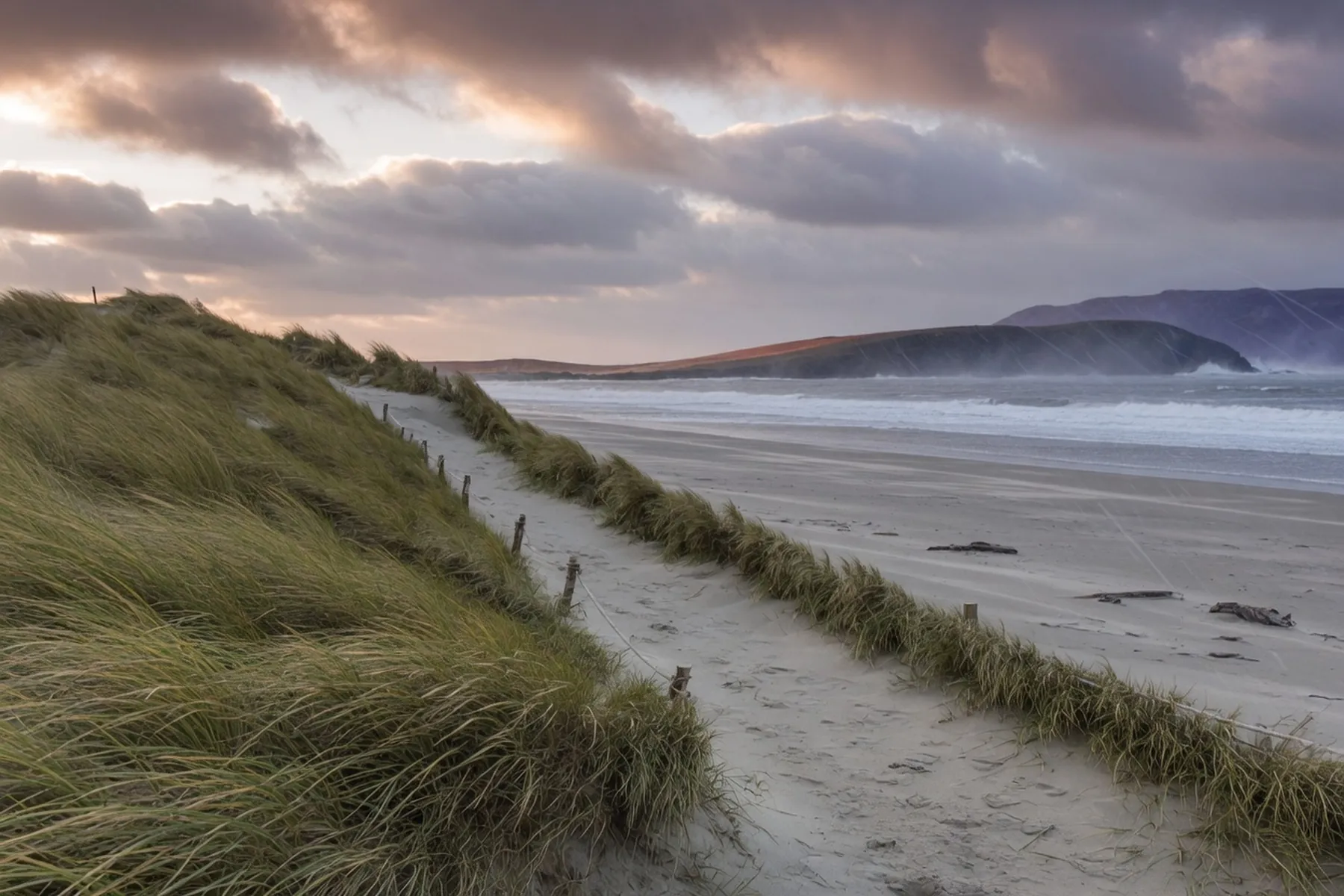
Pembrokeshire in winter is the same coast with the crowds taken out. The beaches empty, the car parks stop charging from November, and the season most visitors skip turns out to have its own calendar: seal pups on Ramsey through autumn into early winter, storms that rewrite the Coast Path, and a run of Christmas markets that ends with a swim in the sea on Boxing Day. Everything below was checked against operator pages in early October 2026; where a date or a price moves, the reader is pointed at the source rather than given a guess.
Winter strips Pembrokeshire back to what the landscape actually is. The boat kiosks and ice-cream huts shut, the summer coastal buses stop, and a walk on the Coast Path becomes a question of wind direction and tide rather than of finding a parking space. What remains is the reason the coast was worth visiting in the first place: long empty sands, the sea at its loudest, and seals. If you can accept short days and a cold wind, this is the season that hands you the county to yourself.
Ramsey Island is the RSPB reserve’s seal nursery. Grey seals pup on all the island’s beaches through late summer and autumn, peaking in September and October with a few pups still arriving into December; winter is when the adults haul out to moult. The island is reached by boat only, from St Justinian’s, with Thousand Islands Expeditions. The reserve’s toilets and shop closed in early October and the island’s facilities shut for winter, so check what is running with Thousand Islands Expeditions on 01437 721721 before you set out.
If you do see seals, the Pembrokeshire Marine Code sets the distances: stay 50 to 100 metres from hauled-out seals, and never land on a pupping beach between 1 August and the end of November. A seal in distress goes to Welsh Marine Life Rescue on 07970 285086 or the RSPCA on 0300 1234 999.
Winter is when the sea puts on its show, and the safest seats are the headlands and clifftop car parks, well back from the edge. A blow changes the path behind you as much as the water in front: storm damage is the usual reason the Coast Path gains a diversion, and the section below explains how to find out before you walk. Watch from a fixed point, keep a full stride of grass between you and the drop, and remember that spray hides how far waves are actually reaching.
The beaches empty in winter, but the tides run bigger, and the Coast Path has crossings that depend on them. Sandy Haven and The Gann (Pickleridge), between Dale and Milford Haven, are passable only about two and a half to three and a half hours either side of low tide; miss the window and the road detour is roughly four miles. A few crossings are affected only by the highest spring tides: the iron bridge at Newport to Newport Sands, Quoits Mill west of Monkton, which floods when tides top 6.5 metres, Bullwell Bay at Popton and Point Lane near Angle. The National Park’s winter advice is to wait out the roughly one-hour spring-tide cover rather than detouring, always check the tide tables, and leave your route with someone.
The Wales Coast Path keeps a temporary-diversions list that changes after every storm. As of early October 2026 it still carried the Amroth landslide closure “until further notice” and a Dale erosion closure. Any list printed here would be out of date before you arrived, so check the diversions page at walescoastpath.gov.uk before you walk. The day-sections piece sets out each stretch, and the walks guide has the routes worth a winter day.
Folly Farm runs daily through Sunday 1 November 2026, then weekends only through November (7–8, 14–15, 21–22 and 28–29) from 10:00 to 16:00, then Friday to Sunday in December (4–6, 11–13 and 18–20) from 10:00 to 16:00, closing from about 21 December for the season. Ramsey’s facilities shut in early October. Carew’s tidal mill closes from 2 November to 15 March 2027. The summer coastal buses finished at the end of September, so winter travel leans on the year-round trains and the T5 and T11 — the coastal buses piece explains what has stopped, and the without-a-car guide covers what still runs.
Pembroke Castle keeps winter hours of 10:00 to 16:00 daily from 1 November 2026 to 2 January 2027, with last entry well before four. It closes on 25–26 and 30 November for Christmas market set-up and clear-up, then 24–26 December and 1 January 2027. An adult is £13 (£14.30 Gift Aid), a child aged 3 to 17 is £9 (£9.90 Gift Aid), under-3s are free and a carer is free; booking online is about ten per cent cheaper. Free guided tours run at 11:00 and 13:00 daily through winter.
Carew Castle, run by the National Park, opens 11:00 to 15:00 from 2 November to 18 December, closes 19–27 December, reopens 28 December to 3 January 2027 at 11:00 to 15:00, then runs 4 January to 5 February from 11:00 to 15:00 on weekdays only. Last admission is 30 minutes before closing. An adult is £9, a child aged 4 to 16 is £7 and a family is £28.50. Both castles’ figures move; the Pembroke guide and Carew guide point at their live pages.
St Davids Cathedral is a working church, generally open Monday to Saturday 10:00 to 16:00 and Sunday 13:00 to 15:00, with hours shifting around services and a suggested donation of £5 an adult. The cathedral sits in its hollow in Britain’s smallest city, and the St Davids piece sets out the day around it. When the rain is horizontal, the rainy-day guide covers Folly Farm’s indoor funfair, the castles and the museums at Scolton and Dre-fach Felindre.
The season builds through late November. Pembroke Castle’s Christmas Market runs Friday 27 to Sunday 29 November (Friday 10:00 to 20:00, Saturday 10:00 to 18:00, Sunday 10:00 to 16:00); entry is free but everyone must book a free ticket online in advance, and Santa’s grotto is £3 a child on Saturday and Sunday from 10:30 to 15:30. The same weekend, Queens Hall Narberth runs its Christmas Market with free entry and a free grotto, and Oriel y Parc in St Davids holds its Christmas Craft Market on Saturday 28 November from 10:00 to 15:00 with free entry and parking. Tenby’s festive day is also Saturday 28 November: the lights switch-on, Santa arriving by RNLI lifeboat, the Santa Run from 11:00 to 12:30, and a market in St Mary’s church grounds.
Earlier, Picton Castle holds its Christmas Fair on Saturday 21 November from 10:00 to 16:00. Later come Carew Castle’s Tudor Christmas on 5–6 and 12–13 December with a “Twelve Days” trail at £2.50 a child and a grotto at £12 a child including castle entry and one adult, and “Tudor Christmas” at the National Trust’s Tudor Merchant’s House in Tenby on Fridays and Saturdays from 27 November to 12 December with last entry at 14:30. The Landsker Singers perform in St Davids Cathedral on Saturday 19 December at 14:30. Every one of these dates belongs to the organiser; check their page before you travel.
The finale is the Tenby Boxing Day Swim on North Beach, Saturday 26 December, with assembly about 11:00 and the swim about 11:30 in fancy dress. Register in advance through tenbyboxingdayswim.co.uk, which also holds the entry details the organiser has not yet published. The Gwaun Valley keeps its own calendar too, with Hen Galan, the old New Year, on 13 January.
The National Park’s car parks charge from 1 March to 31 October only, 9:00 to 19:00 — £1.50 an hour, £4 for two hours, £6 for four hours, £8 all day, coaches £16, all via PayByPhone. From November to February every charging car park is free, and there is no overnight sleeping. The charging list runs Amroth, Saundersfoot Regency, Penally, Manorbier, Freshwater East, West Angle Bay, Little Haven, Broad Haven North, Nolton Haven, Newgale (Pebbles), Solva, Oriel y Parc, Newport Sands and Poppit Sands. The parking guide covers the county’s systems in full.
Start at Pembroke Castle for the 11:00 free guided tour, then walk the walled town and eat lunch in Pembroke before the light thins. The afternoon suits Carew Castle, open to 15:00, with the tidal mill shut for the season but the ruins and the millpond in low winter sun. You are home in the dark by four, which is winter’s honest rhythm; the days-out piece has more ways to stretch a short day.