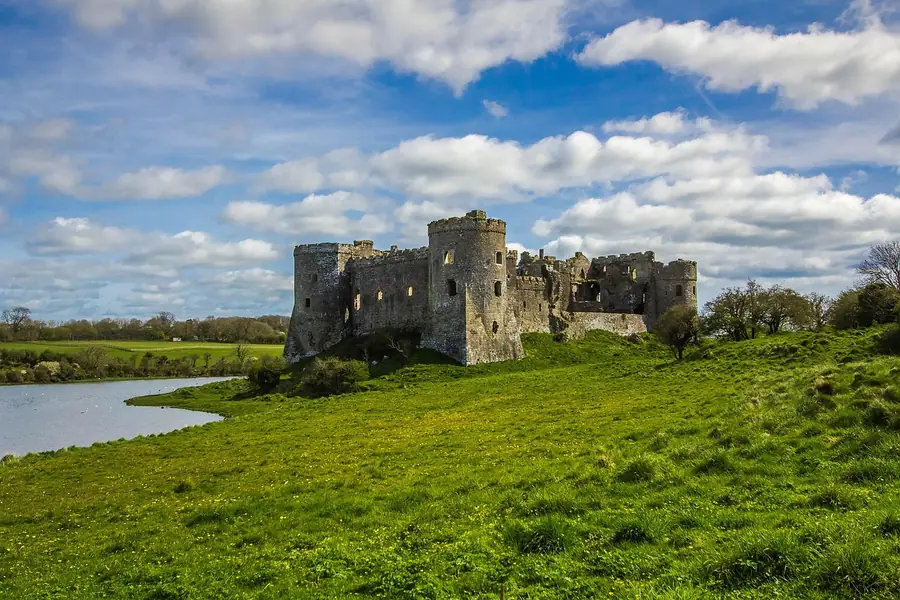
Carew Castle stands on the edge of a tidal millpond sixteen kilometres east of Haverfordwest, and it is unusually interesting because it stopped being one thing and became another without ever being demolished.
The Carew family take their name from the site and have owned it for more than 900 years. It is leased to the Pembrokeshire Coast National Park, which runs it.
The Norman work dates from about 1100, begun by Gerald of Windsor; what survives of it is the Old Tower and the pair of great round towers.
The Elizabethan transformation came in the later sixteenth century under Sir John Perrot — Lord Deputy of Ireland, and widely rumoured to be an illegitimate son of Henry VIII, which he certainly resembled. He drove a vast north range of mullioned windows through the medieval fabric, converting a fortress into a show house.
He never finished it. Perrot was arrested for treason in 1591 and died in the Tower of London the following year, and the range was left as it stood.
The result is the castle’s defining view: defensive towers on one side, a wall of Elizabethan glass on the other, in the same building. Visitors consistently describe it as remarkably complete for a ruin, and the reason is that it was never slighted to the ground.
At the entrance to the site stands the Carew Cross, an eleventh-century Celtic cross over four metres high, carved with interlace and inscribed to Maredudd ap Edwin, king of Deheubarth, who died in 1035.
It is one of the finest early medieval crosses in Wales and it is free to see — it stands by the roadside outside the ticketed area.
A ten-minute walk round the millpond brings you to Carew French Mill, the only restored tidal mill in Wales and one of very few in Britain.
A tidal mill works by trapping the incoming tide behind a causeway and releasing it through the wheels as the tide falls — so it runs twice a day, on a schedule set by the moon rather than the working day. The building dates from the early nineteenth century and the machinery is in place, with an exhibition explaining it.
The walk round the millpond — about a kilometre and a half — is one of the best things here, with the castle reflected in the water and wading birds on the mud.
The National Park runs a substantial events programme: children’s activities and trails through the school holidays, outdoor theatre in the castle grounds on summer evenings, ghost tours, and archaeology open days.
Visitors specifically mention the children’s activities and the outdoor plays, and both are worth checking before you book a date.
Admission charged and widely described as reasonable; it covers both the castle and the tidal mill.
Time: two to three hours including the millpond walk.
Facilities: tea room, shop, toilets.
Access: level ground almost everywhere inside the grounds, stairs once you go up a tower, and an unsurfaced stretch or two on the millpond circuit.
Season: the castle and mill are seasonal — check opening before travelling. The Carew Cross and the millpond walk are accessible year-round.
Parking: on site.
The Carew Inn opposite the cross is a good pub.
Both — a Norman fortress with a huge unfinished Elizabethan range driven through it in the 1580s by Sir John Perrot.
An eleventh-century Celtic cross over four metres high, commemorating Maredudd ap Edwin. It stands outside the ticketed area and is free to see.
A watermill powered by trapping the incoming tide and releasing it through the wheels as it falls, so it works twice a day on the tide. Carew’s is the only restored one in Wales.
Yes, admission covers both the castle and the tidal mill.
Two to three hours, including the walk round the millpond.