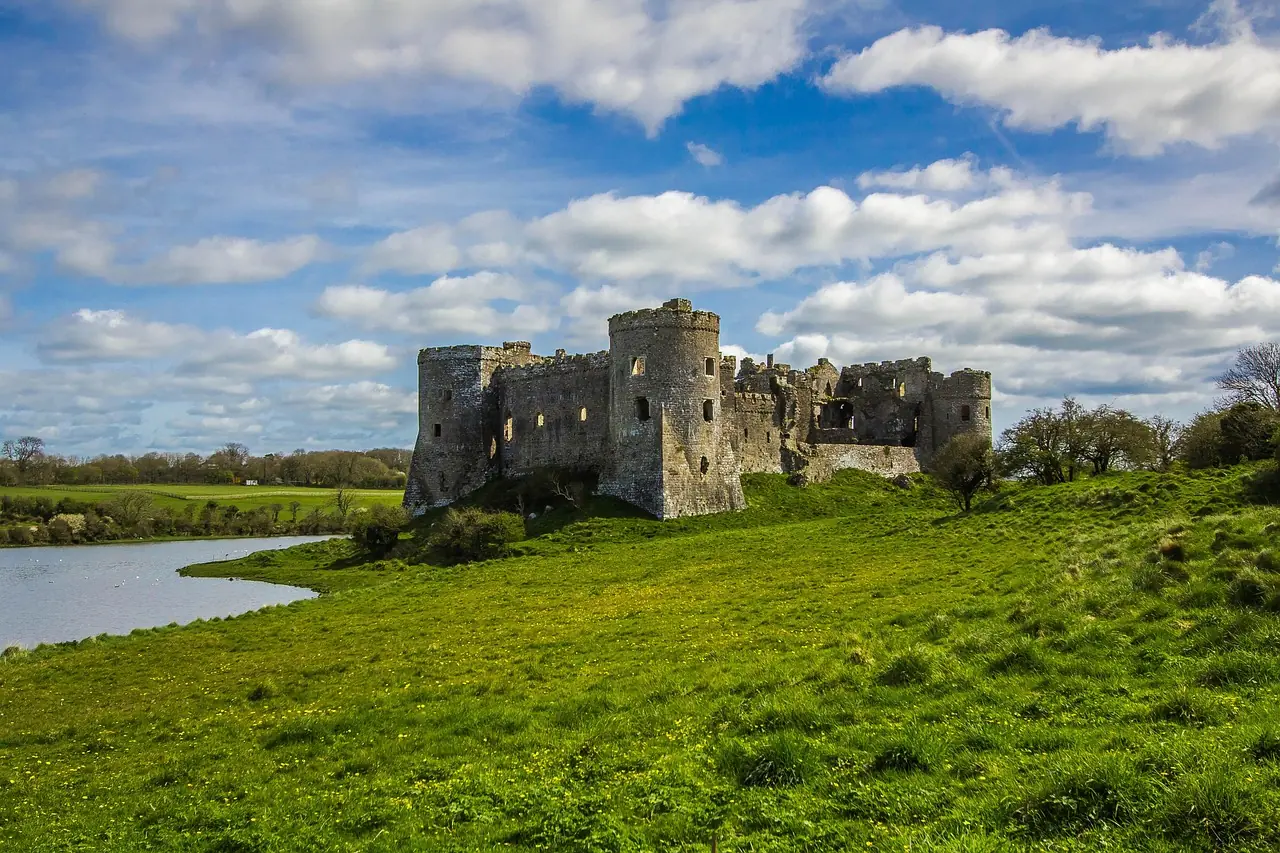
Carew Castle stands on the edge of a 23-acre millpond, a few miles east of Pembroke, and it is the castle people drive past on the way to Tenby and then wish they had stopped for. From the west it is a Norman fortress. From the north it is an unfinished Elizabethan mansion, a wall of mullioned glass looking at its own reflection. The same building is both, which is the point.
It is run by the Pembrokeshire Coast National Park, not by English Heritage or Cadw, and it is not Pembroke Castle. Pembroke is the great round keep and the birthplace of Henry VII. Carew is the one with the millpond, the mill and the Celtic cross at the gate. Allow two to three hours including the walk. Check opening times before you set out — the mill and the castle do not keep identical hours.
This is the confusion worth killing first.
Pembroke is ten miles down the same waterway, a vast fortress on a rock, privately owned, with a 24-metre keep and Wogan’s Cavern underneath. It is the county’s headline castle. Carew is a family seat that became a show house and then a ruin, leased to the National Park since 1983. The Carews have held the site for more than 900 years. The two places share a river system and a Norman origin. They do not share a ticket, a car park or a mood.
If you have one castle afternoon, Pembroke is the bigger object. If you have a morning and you want water, birds and a mill as well as stone, Carew is the better hour. Doing both in a day is easy: they are a short drive apart, and the Castle to Castle multi-use path runs beside the A477 between Pembroke Dock and Carew if you would rather not drive the second leg.
The site is older than the Normans — an Iron Age promontory fort, Roman pottery, perhaps a Dark Age settlement. What you walk through starts at the end of the eleventh century, when Gerald de Windsor, constable of Pembroke for Henry I, built his own fortification up the tidal waterway. His wife was Princess Nest. Their grandson, Gerald of Wales, was born at Manorbier, not here.
Gerald’s work was earth and timber. The stone castle is largely Sir Nicholas de Carew, dead in 1311, who put up the east and west ranges. In the late fifteenth century Sir Rhys ap Thomas — who “ruled this corner of Wales like a king” under the first two Tudors — improved both and put in the Bath-stone windows. The last campaign is the one you photograph.
Sir John Perrot, Lord Deputy of Ireland, born at Haroldston in 1530 and widely rumoured to be an illegitimate son of Henry VIII, drove a vast north range of mullioned windows through the medieval fabric in the 1580s. He was converting a fortress into a house that would look at the millpond. He never finished it. Arrested for treason in 1591, he died in the Tower the following year, and the range was left as it stood.
The Civil War did the rest. The castle changed hands four times; the south side, including the kitchens, was slighted. It was abandoned in 1686. It was never razed, which is why so much of it can still be read: defensive towers on one side, a wall of Elizabethan glass on the other.
The National Park’s restoration, grant-aided by Cadw, reinstated the Lesser Hall roof and added the Nest Tearoom in the walled garden. The castle is a Site of Special Scientific Interest for its bats, which is why some interiors close at dusk.
At the entrance, outside the ticketed area, stands the Carew Cross: an eleventh-century Celtic cross more than four metres high, carved with interlace and inscribed to Maredudd ap Edwin, king of Deheubarth, who died in 1035. It is one of the finest early medieval crosses in Wales, and it is free. You can see it without buying a ticket, from the road, at any hour.
Do not treat it as a two-minute pause on the way to Pembroke. It is the reason this particular river-bend already mattered before Gerald put a palisade on it.
A ten-minute walk round the millpond brings you to Carew Tidal Mill — the French Mill — the only restored tidal mill in Wales and one of a handful in Britain. A mill of some kind is documented here from the 1540s; the present building is early nineteenth century, one wheel dated 1801. It worked until 1937, sat derelict, and was restored in 1972.
A tidal mill traps the incoming tide behind a causeway and releases it through the wheels as the water falls, so it runs twice a day on a schedule set by the moon. The machinery is in place. There is an exhibition and an audio tour. Access is by steps. There are no toilets at the mill; those are back at the castle.
The mill is more seasonal than the castle. In a recent season it closed through the winter and reopened in late March. Do not plan a mill visit off a castle opening time copied from July. Check the National Park page. The causeway outside is a well-known crabbing spot at high tide. The millpond itself is not for boats or paddleboards — a conservation rule, not a suggestion.
The mile-long circuit around the pond is the thing a lot of castle visitors undercook. The castle reflects in the water. Wading birds work the mud. The path is suitable for buggies and wheelchairs, with an unsurfaced stretch or two, and a picnic site on the north side.
You can walk the pond without going into the castle. The cross, the bridge, the water and the view of Perrot’s windows are the free half of the site. The paid half is the interiors, the mill and the events. Both are worth it; they are not the same visit. Dogs are welcome in the castle on a short lead.
Admission is charged and covers castle and mill together. Figures move; the opening-times page is the tariff, not a paragraph in a guide. Last admission is thirty minutes before closing. Parish residents, wheelchair users and carers, and annual-pass holders go in free with the right proof. An annual pass covers Carew and Castell Henllys.
A recent pattern, which you should confirm rather than treat as eternal: the castle on short winter hours from late February, then full days from late March to the start of November; the mill shut in winter and open through that same main season; the Nest Tearoom tracking the castle more closely than the mill. A private wedding can close the castle for an afternoon while the mill and tea room stay open. Check the week you are travelling.
The National Park runs a full events programme: children’s trails in the holidays, open-air theatre, ghost tours, archery. If you are coming for a play, you are coming for a play. If you are coming for a quiet millpond, pick a morning that is not one.
Three castles, three jobs.
Pembroke is the fortress: keep, wall walks, cavern, Henry VII. Two to three hours, and the one to do first if the children will only tolerate one set of spiral stairs. Carew is the house-and-water visit. Manorbier is the small Norman castle above a beach, birthplace of Gerald of Wales, privately owned, an hour to ninety minutes combined with the sand and the church.
A south-county day that works: Carew in the morning — cross, castle, mill, pond — lunch at the Carew Inn opposite the cross, Pembroke in the afternoon. Do not add Manorbier unless everyone in the car is a castle person. It sits on the way to Tenby, which is a different day.
Parking at Carew is on site. The nearest stations are Pembroke Dock and Kilgetty, neither of them a walk. The old 360 and 361 buses have been replaced by Fflecsi — bookable, not a timetable you stand at. A car is the honest tool for this particular ruin. Our parking guide covers the rest of the county.
Time: two to three hours if you do the mill and the pond; an hour if you only do the cross and the view.
Facilities: visitor centre, shop, Nest Tearoom, toilets at the castle. None at the mill.
Access: level ground almost everywhere in the grounds; stairs into the towers and into the mill. A mobility scooter is available to hire.
Season: the millpond and the cross are there all year. The interiors are not. Out of season, check.
What it is not: a substitute for Pembroke, or a wet-weather hall of the Folly Farm kind. It is a ruin with a roof on parts of it, a mill that works on the tide, and one of the best stretches of still water in the county. That is enough.