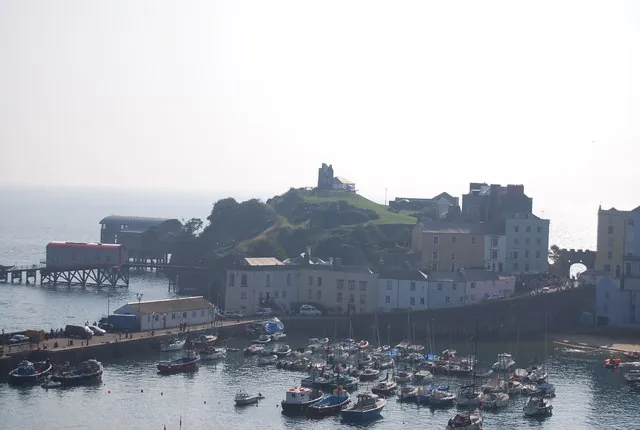
Tenby Castle stood on Castle Hill, the headland separated from the town by a narrow isthmus, and what survives is a fragment: a gate tower, sections of wall, and a watchtower on the summit.
The stone remains date from the thirteenth century, though the castle is mentioned as early as 1153, when it was attacked by the Welsh. It is Grade II* listed.
It is free, always open, and the headland it sits on is the reason to come.
Tenby’s castle was never large. The town’s real defence was its town walls, which are substantial and largely survive — including the Five Arches barbican gate, one of the finest medieval town gates in Britain, still standing at the top of the town.
The castle guarded the harbour and the headland. It was taken by the Welsh more than once, damaged in the Civil War, and quarried thereafter. By the nineteenth century it was a picturesque ruin, and Castle Hill was landscaped as a public promenade — which is why the remains sit in what is essentially a Victorian park.
The headland is the attraction.
The view runs the full circle: North Beach and the town walls one way, the harbour and South Beach the other, Caldey Island offshore, and the whole sweep of Carmarthen Bay. It is the best free viewpoint in south Pembrokeshire.
The Prince Albert Memorial — a statue of 1865, one of the first raised to him after his death, standing on the summit.
The Tenby Museum and Art Gallery, on the hill in the castle’s former grounds, is the oldest independent museum in Wales, founded in 1878. It covers local geology, archaeology, maritime history and art, including work by Augustus and Gwen John, both born in Tenby. It charges and is worth an hour.
Benches, lawns and paths round the headland, and a lifeboat station below.
The castle is a ten-minute stop; the town is a day.
The walled town — narrow streets of pastel-painted Georgian houses inside a substantially complete medieval wall circuit.
Three beaches — North, Castle and South — all sandy, all excellent.
The harbour, working and picturesque, with boats to Caldey Island and its Cistercian monastery.
The Tudor Merchant’s House, National Trust, a late fifteenth-century town house furnished as it would have been.
St Mary’s Church, the largest parish church in Wales.
Free, open at all times.
Time: twenty to thirty minutes on the hill; longer with the museum.
Access: Castle Hill is a climb from the harbour, on paths and steps. The upper paths are uneven.
Parking: Tenby’s town car parks; the walled town is largely pedestrianised in season and driving in is restricted.
Getting there: Tenby station is a few minutes’ walk, on the Pembroke Dock line.
Not of the castle itself — a gate tower, some wall and a watchtower. The headland, the view and the museum are why people go up.
Yes — the headland itself costs nothing and is never closed. Admission is charged only at the museum up on the hill.
Twenty to thirty minutes for the hill, or an hour or two with the museum.
Tenby Museum and Art Gallery, founded in 1878 and the oldest independent museum in Wales, with work by Augustus and Gwen John.
The town walls and Five Arches gate, the Tudor Merchant’s House, the harbour, the three beaches and the boat to Caldey Island.