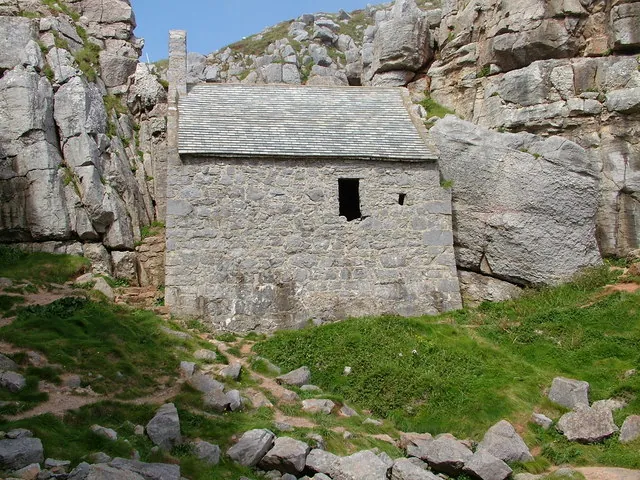
St Govan’s Chapel is built into the side of a limestone cliff at St Govan’s Head, near Bosherston on the south Pembrokeshire coast, and it is one of the strangest religious buildings in Britain.
It measures about 20 by 12 feet — 6.1 by 3.7 metres — with walls of limestone, two chambers, and a roof at the level of the surrounding rock. It sits in a cleft in the cliff face, invisible from above until you are almost on top of it, with the sea below.
Most of the fabric is thirteenth century; parts may go back to the sixth, when St Govan, a monk, is said to have taken up residence in a cave on the site.
Govan is traditionally identified with a sixth-century Irish monk, possibly the abbot of Dairinis, who came to Wales in old age.
The legend runs that he was pursued along this coast by pirates, and that the cliff opened to conceal him, closing round him until they had gone. He stayed for the rest of his life, and the chapel was built where the cleft had been.
Inside, there is a fissure in the rock at the back — pointed out as the one that hid him — and a bell legend: Govan’s silver bell was stolen by pirates, angels recovered it and sealed it inside a rock, and striking that rock produced the sound of the bell.
There was a holy well below, now dry, which was a place of pilgrimage into the nineteenth century.
You reach the chapel down a flight of stone steps from the clifftop.
The tradition is that the steps cannot be counted the same going down and coming up. This is entirely explicable — they are uneven, irregular and worn, and it is genuinely difficult to keep count — and people still try, which is the right response.
Below the chapel the rocks run down to the sea, and on a hot day the shade in the cleft and a seat on the rocks is one of the more pleasant things on this coast.
The chapel is inside the Castlemartin Range, an active Ministry of Defence live-firing area, and access depends entirely on whether firing is taking place.
The road is closed when the range is in use. Red flags fly, and the closure is absolute.
Check the firing times before you travel. They are published in advance by the MOD and by the National Park, and appear in the local press. Weekends and holidays are generally open, weekdays often not.
This is not a formality. Visitors who drive out without checking find a barrier.
The Castlemartin limestone coast is the finest in Britain and the range is what has preserved it — no development, no agriculture up to the edge, and consequently exceptional wildlife.
The Green Bridge of Wales, a natural limestone arch, and the Elegug Stacks, sea stacks packed with breeding guillemots and razorbills in spring and summer, are a few kilometres west along the same road — also range-dependent.
Huntsman’s Leap, a spectacular narrow chasm, is a short walk east and is a famous rock-climbing venue.
Bosherston Lily Ponds and Broad Haven South, on the National Trust’s Stackpole Estate, are just inland and are always open.
Free, with a free car park at the clifftop.
Time: twenty minutes for the chapel; longer with the coast path.
Facilities: nothing on site at all — the nearest are the pub and tea rooms in Bosherston.
Access: the steps are steep, uneven and unrailed. The chapel is not accessible.
Safety: unfenced clifftop, and do not stray off marked paths anywhere on the range — unexploded ordnance is a real hazard.
Mostly thirteenth century, with parts possibly dating to the sixth century when St Govan is said to have lived here.
No. It stands inside the Castlemartin live-firing range, and the access road shuts whenever firing is on. Check published firing times before travelling.
Yes, with a free car park at the top of the steps.
Tradition says not — they are uneven and worn, and counts rarely agree in both directions.
The Green Bridge of Wales, the Elegug Stacks, Huntsman’s Leap, and the Bosherston Lily Ponds on the Stackpole Estate.